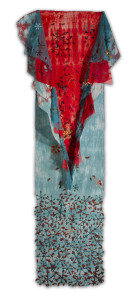
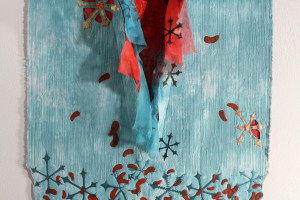

I am very excited to complete the first two works of my new series, Family Portraits. This series lies at the intersection of heritage and family history, art history and digital technology, craft and fine art, grief, memory, mental illness, addiction, and love.
I am 3/4 Belgian-American, and I am lucky to have visited Belgium several times. This series involves combing through boxes of family photographs and researching the art of the Flemish masters. A digital collage is printed onto cotton fabric, layered with lace, batting, and backing and stitched by and/or machine. Each portrait is an homage, an exploration of family dynamics and grief. All is done without the use of AI.
When I look at this work, I cannot believe the painter is unknown, let alone the dressmakers. That dress is gloriously ridiculous. It must have taken teams of lacemakers and dressmakers months to complete. The dress itself is a masterpiece, and the painter painstakingly recreated each strand of lace with the stroke of a brush.
Countess Ursula’s stunning gown inspired me to create an homage to my Nana, Rosella Van Belle, my mother’s stepmother. Nana was the Martha Stewart of here day. She cultivated a lovely rose garden, was a great cook, dressmaker, and hosted a magical Christmas Eve celebration throughout my childhood. It was always a highlight of my year.
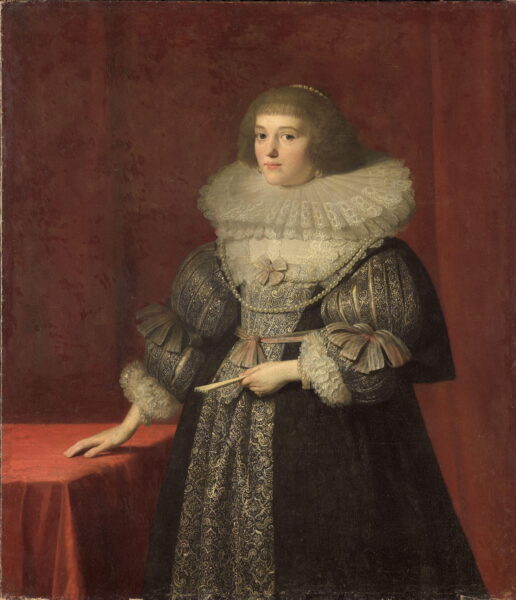
Countess Ursula’s stunning gown inspired me to create an homage to my Nana, Rosella Van Belle, my mother’s stepmother. Nana was the Martha Stewart of her day. She cultivated a lovely rose garden, was a great cook, dressmaker and needle worker. She hosted a magical Christmas Eve celebration throughout my childhood. It was always a highlight of my year.
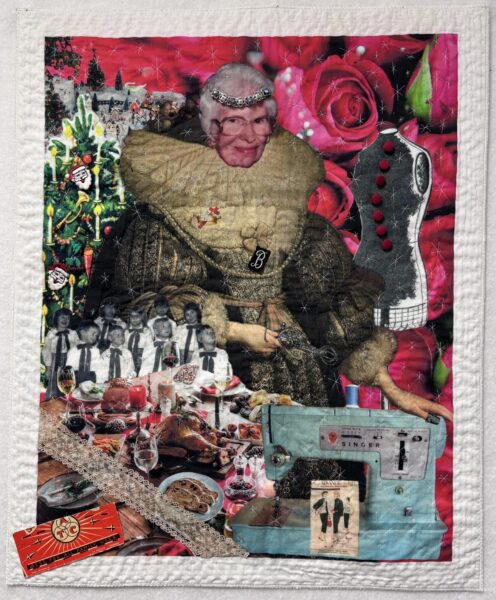
The digital collage includes a picture of her grandchildren singing Christmas carols, her Singer sewing machine, a fantastic bit of handmade lace, and buttons, patches, and the cover of a needle packet from her sewing box. There is some of her best-loved cookies on the table, along with a Christmas stollen. She is crowned with one of her bracelets.
And now for something completely different….
I am very excited to complete the first two works of my new series, Family Portraits. This series lies at the intersection of heritage and family history, art history and digital technology, craft and fine art, grief, memory, mental illness, addiction, and love.
I am 3/4 Belgian-American, and I am lucky to have visited Belgium several times. This series involves combing through boxes of family photographs and researching the art of the Flemish masters. A digital collage is printed onto cotton fabric, layered with lace, batting, and backing and stitched by and/or machine. Each portrait is an homage, an exploration of family dynamics and grief. All is done without the use of AI.
The first work is based on Jan Steen’s famous Merry Family. There is a lot going on in this painting! You can learn all about it here at the Rijksmuseum.
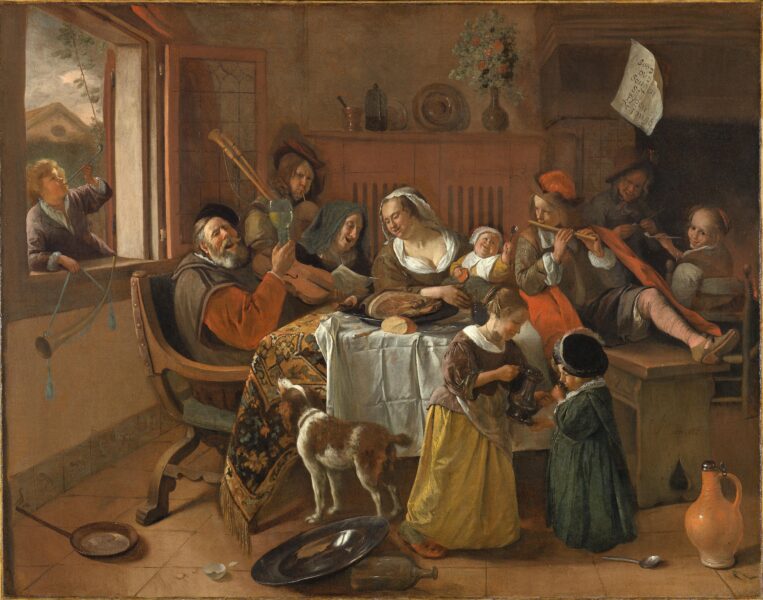
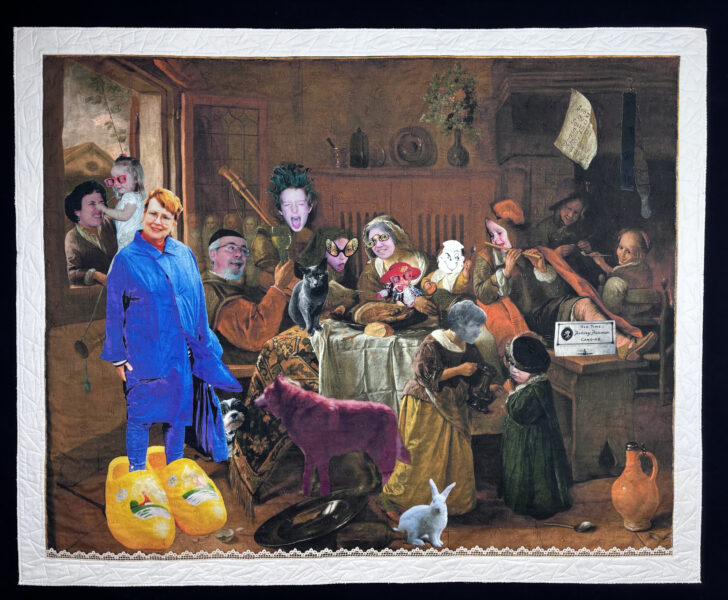
I feel this is a rich vein for exploration, and I love finding the perfect elements to combine in a collage. What do you think?
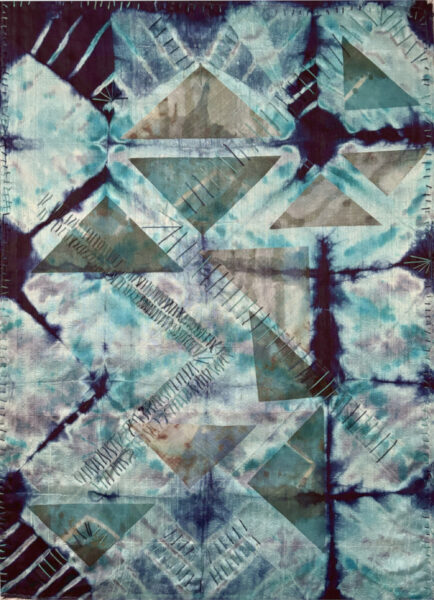
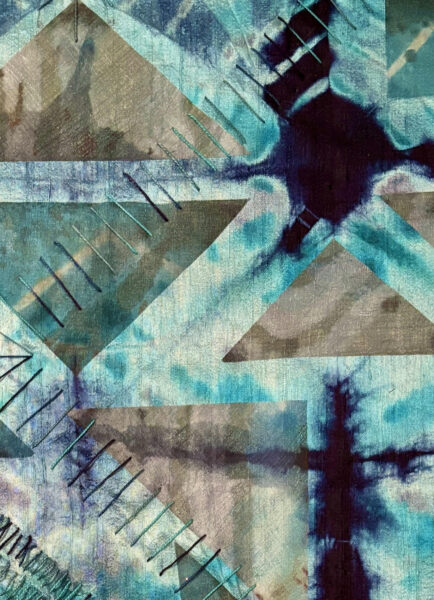
My Where Do We Go From Here? series explores way-finding in a chaotic world. I take Japanese shibori hand-dying techniques and reinterpret an old art form for contemporary times. See this work while it is on tour at the Art Cloth Network travelling exhibition, ReVision. It is layered hand-dyed silk fabrics with hand-stitching.
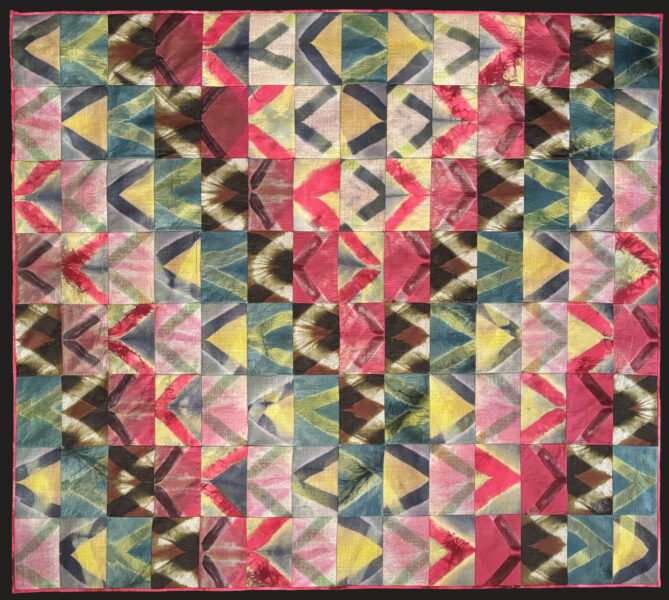
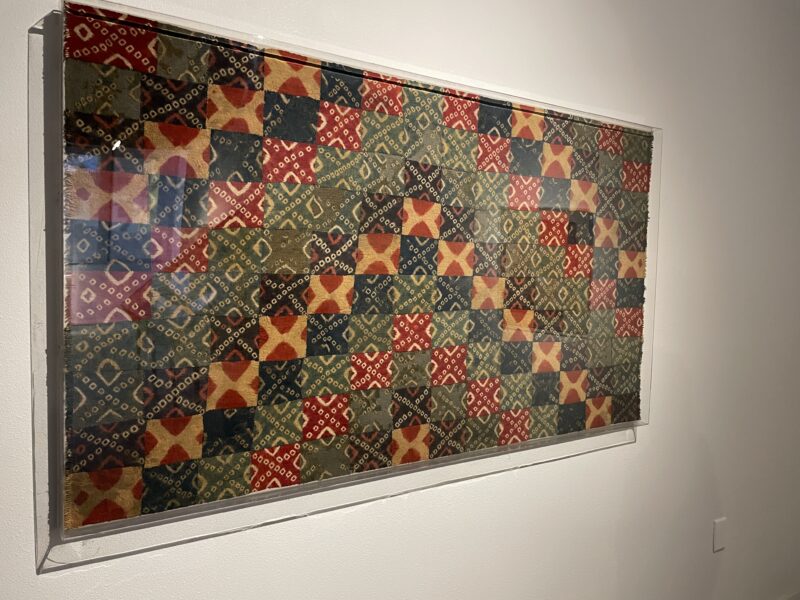
In the Where Do We Go From Here? series, I explore way-finding in a complex and chaotic world. This piece was inspired by the ancient Peruvian Wari textile below, and the American quilt block called ‘flying geese.’ I love to combine elements of old and new to create a new ‘species’ of textile art.
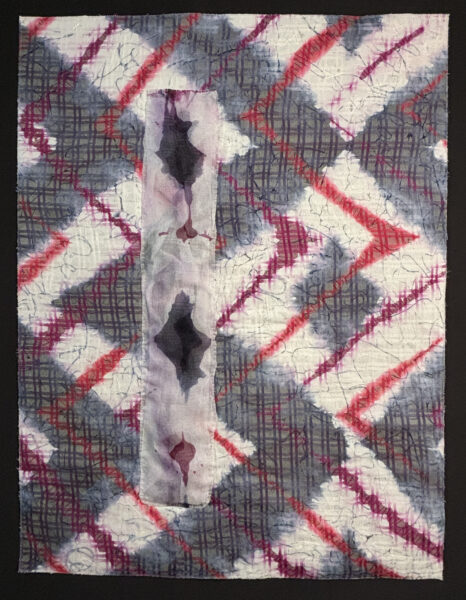
A ‘deconstructed American flag,’ this work’s title references Yeats’ poem, The Second Coming. It is layered hand-dyed silks, fused and hand-stitched. The Where Do We Go From Here? series explores way-finding in a chaotic world.
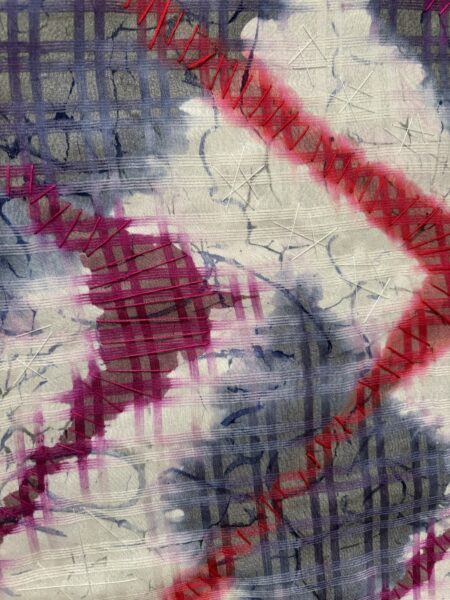
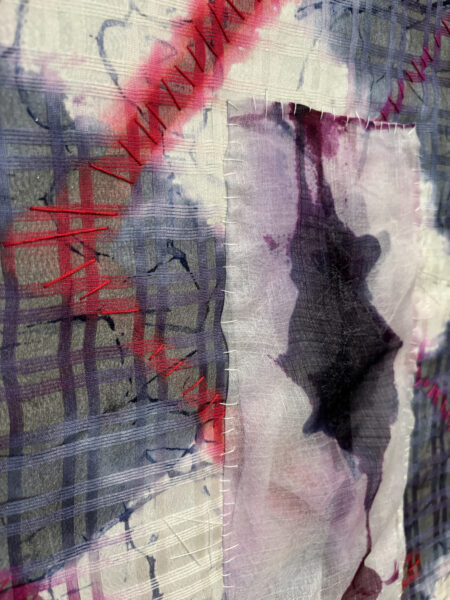


I am ending 2023 with the first piece in a new series, “Where do we go from here?”. I feel I am at a crossroads (and our country is, too). I’m wrapping up a huge multi-year project (have you heard of it?)… supporting loved ones with serious medical issues… grieving my parents and the sense of mortality that comes with that loss.
No, I don’t have 2 actual boyfriends. The first class I took with Jane Dunnewold was about applying color, line, and shapes to plain fabric. She warned us that some of us would come to her with our ‘boyfriends’–fabrics we had created and loved so much that we wouldn’t want to change them. I have been hanging on to these boyfriends for years, wondering what in the heck to do with them. Here I have appliquéd a sheer silk organza boyfriend onto a Fuji silk broadcloth that was dyed using a Katano shibori method. Hand stitched with single strand embroidery thread (this was really tough on my hands and I won’t be able to handwork an overall design again any time soon).
I kinda like the new guy. What do you think?
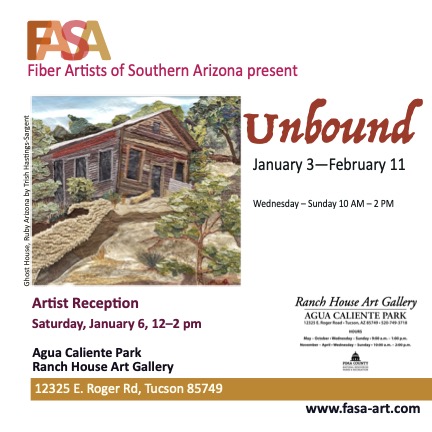
You can see the work at Agua Caliente Park in Tucson. Show details below. I am looking forward to a productive and art-filled 2024 with some new friends and exciting challenges. What is on your calendar?
I will temporarily move my studio to St. Gregory’s School at 3231 N. Craycroft for the 2013 Open Studio Tour this weekend. Janet Windsor and Patricia Hastings-Sargent and Joanne Krawchuk and I will all be in one convenient place. We’ll will demonstrate some of our techniques, from design processes to quilting. Hope to see you there (11 am – 5 pm this Saturday and Sunday).
Come join us for some fun, friends, and fiber art. The event is free and open to the public.
It is always a good day in the studio when I get to open the dyepot and pet some new fabrics. This week I was exploring some shibori techniques I learned over the summer and I spent part of the day perusing the results. Looking closely at the details. Planning the next process. Is the fabric ready for a discharge bath or another layer of dye? Or does it only need a bit of paint and quilting to finish? Is the piece destined to remain whole, or be cut into several smaller works? Which side of the fabric do I like best? Do I want to see what the same technique does for a different type of fabric? So many questions to ponder.
It was with a jolt then that I realized that there was an angel in this fabric I have been pondering now for days. She (do angels have a gender?) is small, about three inches tall. She is standing in front of a rainbow. I am not making this up. Under two white doves, no less. I tell you, it does not get more kitschy than this: the top three trite images you can think of, sitting there on my stitch dyed silk. And I certainly did not plan one treacly iota of it….
In the midst of rust-dyeing one day, my friend Peggie found Don Quixote and his sidekick looking strangely reminiscent of this famous sketch by Pablo Picasso. That is really cool. But Pablo wasn’t haunting my dyepot…. It was the Angel of Sweetness and Light. I don’t know whether to put her on my design wall as the patron saint of my studio, hand quilt her into oblivion and sell her for double the price of my other little gems, or banish her into a boiling discharge bath….what would you do?

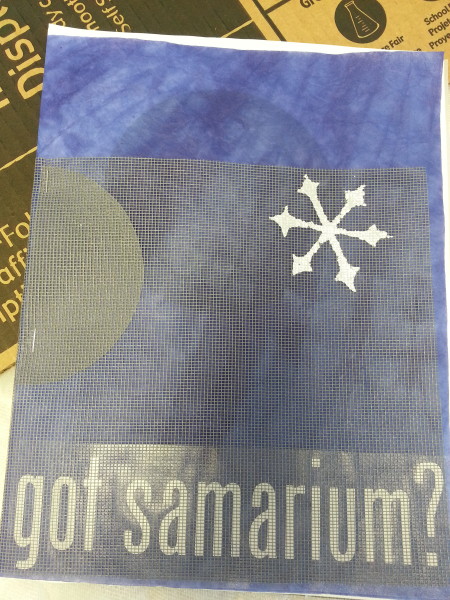
One year later, my piece for the Studio Art Quilt Associates’ exhibition Radical Elements is complete. It is a huge relief to have the work done, photographed, and shipped to Ohio, where it will stay until its debut in May in Baltimore. When I applied to be a part of the exhibition, I did not realize the pressure I would put myself under to complete the piece.
When you apply to most shows, you submit photos of a finished work. If the juror(s) like it, it gets in. If they don’t, you apply somewhere else. For this exhibition, artists were accepted based on their portfolios. Then we made work specifically for submission to the exhibition. So you have to make a terrific piece and hope it lives up to your reputation. Hope that it holds its own next to that of the other artists. Yikes.
I won’t do that again–anytime soon anyway.
What ‘radical elements’ did I use in the piece? Archival tyvek collaged with decorative papers. A medical exam glove. Window screen. Magnets. Guitar strings. Some of these elements evoke the uses of Samarium. Others allowed me to use my surface design techniques without fabric. I included my new favorite technique of designing a portion of the piece to fall forward off the wall with gravity. Radical indeed, don’t you think?
I can’t show you a full photograph, but here are some teasers:
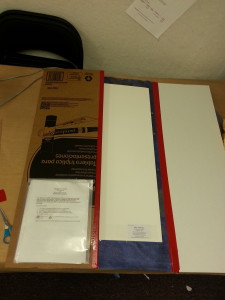
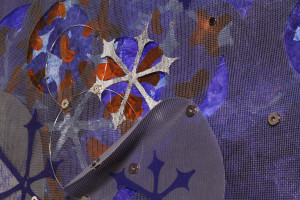
If you see me in person I can show you a full size picture…. Have you ever finished an imporant piece ‘just in the nick of time?’
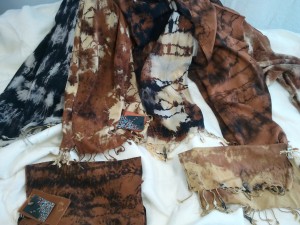
I spent a week on Whidbey Island with Elin Noble and 14 other artists learning the art of shibori while discharging and dyeing fabrics. It was wonderful! We tried clamping, stitching, arashi (pole-wrapping) and masking a raft of different fabrics: silk dupion, cotton, rayon twill, etc.
Elin is very knowledgeable about the chemistry of the dyeing and discharging process. Armed with that knowledge, you can analyze what happened on a piece of fabric, and predict what will happen on another. How great is that!?
Here are a few of my favorite pieces from the week:
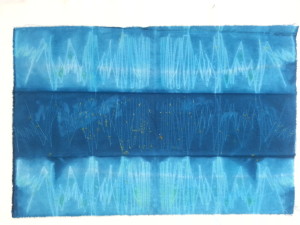
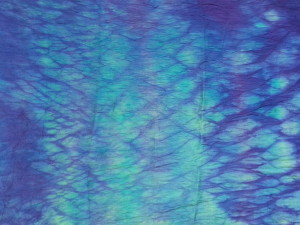
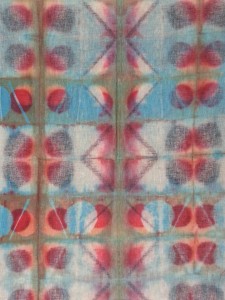
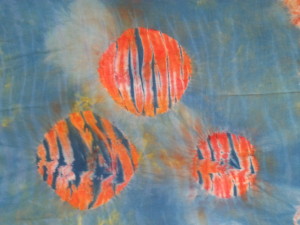
The setting was beautiful. This is not a postcard–it is an actual picture I took from the deck of the Cottage on the Cove:
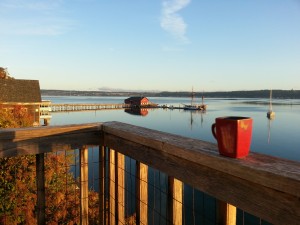
Sometimes I think I am the luckiest person on Earth.
After a week on Whidbey Island, I spent a week in Seattle, and visited the Seattle Art Museum AND the La Conner Quilt Museum. More on those wonderful outings later….
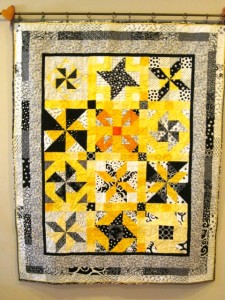
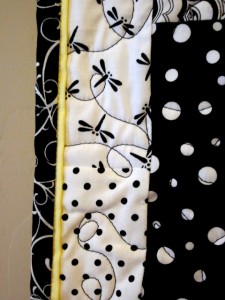

Window screen with gel medium, silk fibers, screen printing, embellishments.
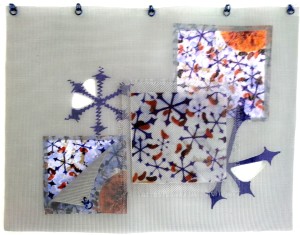
This piece is a small ‘quilted’ collage made from window screen, kozu and lace papers with digital and hand-printed images, layered and stitched. With cutouts and found objects.
Sure wish I could be at the opening reception of Quilt for Change’s new exhibition. The show will travel in the US later this year. Details to follow.
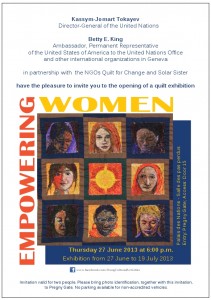
This is the piece I submitted:
The 2013 SDA conference was a terrific and inspiring program with artists on the cutting edge in their respective fields. These are just three of my favorites.
Otto von Busch discussed his fashion hacktivism (check it out here). He offered intriguing ways to subvert the ‘fashion industrial complex.’
Kim Bruning spoke about how she puts electronics into textiles. One project she completed was a leather jacket for a blind woman that would sense objects within 30 inches and vibrated the collar so the wearer could discretely avoid a ‘collision.’ For info on how she works and DIY, click here.
Another speaker was Janet Echelman, who has collaborated with computer graphic designers and textile manufacturers to create her gorgeous permanent outdoor textile sculptures. She has a piece in Phoenix, and I plan to see it the next time I am in town. A link to her TED talk is here.
In addition to a phenomenal speakers program, several galleries around San Antonio featured some outstanding member work. These are just a few of the pieces that caught my eye. Which one is your favorite?
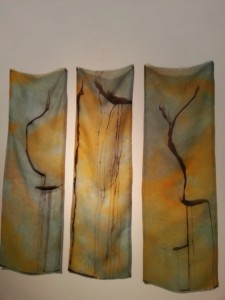
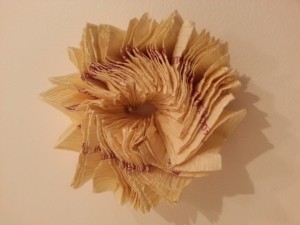
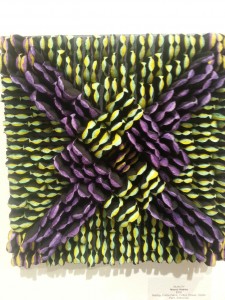
Already planning for the next conference in Tulsa in 2015.
I am honored to be a part of the newly published book by Mary W. Kerr called Cutting Edge Art Quilts. Fifty artists who work in the quilt medium are included. A link to more information is here.

Quilt for Change recently asked me to submit a piece for their Light, Hope, and Opportunity Challenge. The project raises awareness about the Solar Sisters program, where African women entrepreneurs are given loans to start their own businesses. They buy inexpensive rechargeable solar lights to sell in their communities. This means fewer costly and dangerous kerosene lanterns in African villages. What a great cause! The exhibition will start in Geneva next month, and hopefully travel to the US.
I have been thinking about burning the edges of a piece for a while, and this seemed like an excellent opportunity.
Here is my artist statement for the piece:
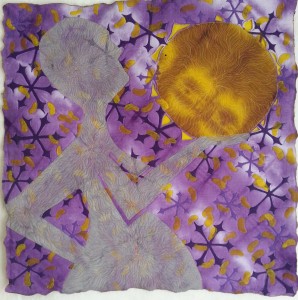
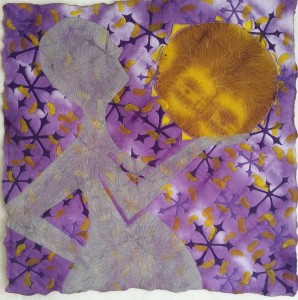
Lucina Lighting the Way
Lucina was the Roman goddess of light and childbirth: She who brings children into the light. Here, the pregnant goddess holds a golden orb. The lively color scheme and bright shapes evoke a hopeful spring. This quilt is a tribute to modern-day Lucinas, our Solar Sisters, who are bringing safe, affordable, solar-powered light to their friends and neighbors. The singed edges are a reminder of the dangers of kerosene lanterns, which maim and kill users across Africa each year. Hand-dyed, and printed linen, painted silk, layered and machine stitched. Techniques include cutwork with a burned-edge finish.
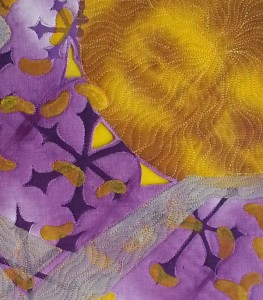
detail:
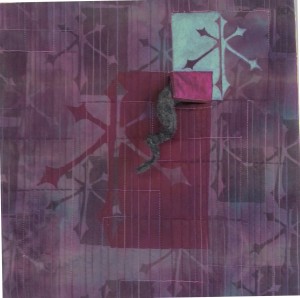
Sans Samaras is hand-dyed, discharged and over-dyed silk dupion, hand-printed, layered, stitched and stretched on a frame. With felted wool embellishment. In a private collection.
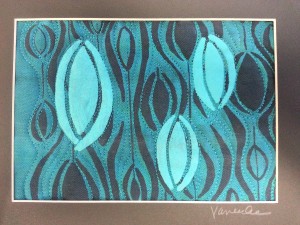
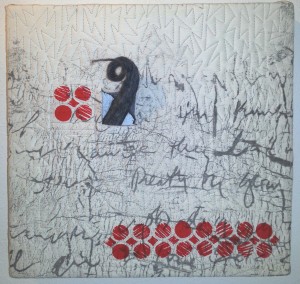 Handpainted and screen-printed silk, layered, stitched, stretched on a frame, with felted wool embellishment. In a private collection.
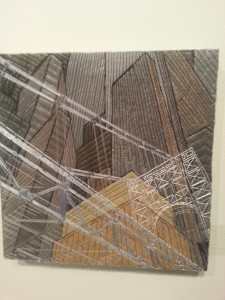
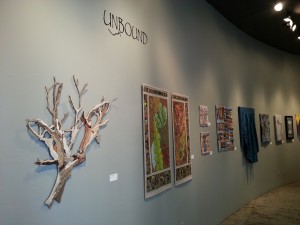
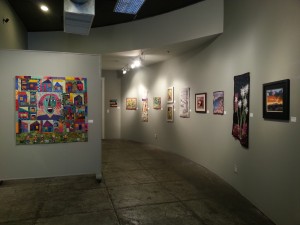
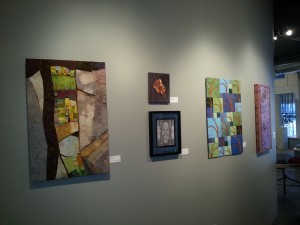
The Fiber Artists of Southern Arizona’s show UNBOUND opens at The Drawing Studio in Tucson on Saturday. The show looks amazing, and the works include my 8′ skyscraper Channeling Gehry and Trish Hastings-Sargent’s new work, a sculptural Desert Tree that ‘floats’ along the wall. My artist talk Confessions of a Subversive Stitcher begins at 5 pm Saturday. The artists’ reception follows at 6 pm. Patricia Hastings-Sargent will host a talk about how she creates her landscapes on Saturday, April 13 at 5 pm.
Click here for info on how to get to The Drawing Studio. Events are free and open to the public. The show runs through April 27, hope you can stop by and see it.
Here is a sneak peak of the show….

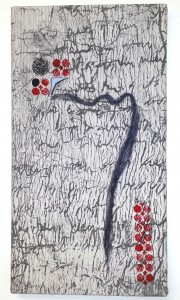
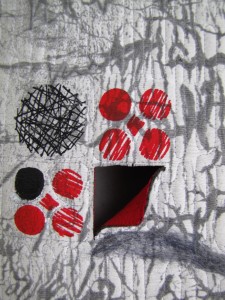
Zen I, 2013. Hand-painted, screen- printed silk with felted wool, layered, stitched, cut and stretched on a frame. 26” x 14.”
BEHIND THE SCREEN – A FREE DEMONSTRATION
OF THE
THERMOFAX SCREEN PRINTING TECHNIQUE
Did you ever wonder how a thermofax screen works? How to make one from your own photo? How to incorporate them into your art quilts? What is the difference between thermofax and silkscreens? Where can you get them locally? Get answers to all your questions and try the technique for yourself.
Saturday, March 9, 2013
1:00 -2:00 pm and 2:00-3:00
Seating is limited. Please RSVP to
mary@maryvaneecke.com or 520-444-7149
At my studio, 2000 S. Hermosa, near Starr Pass and I-10. Go west on 22nd St., left on Greasewood, right on San Juan Terrace, left on Hermosa. Follow the path through the gate to studio in back of the house.
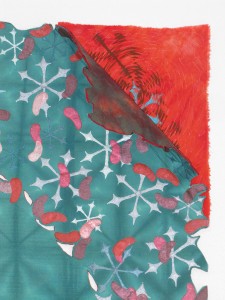
Well, I must report that my papermaking adventure with artist Catherine Nash was not a complete success. The class was wonderful and informative (I have a new found respect for the art and tradition of papermaking.) I dutifully made a sheaf of lovely papers embedded with golden colored maple seeds, dyed silk fibers and thread, and dyed papers in the class.
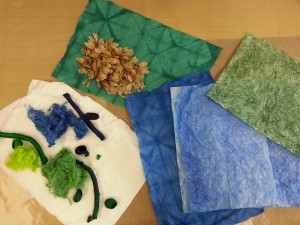
Brought them home to dry. Stuck them on my doorwall (this is called ‘restraint drying’ in paper-making lingo). They looked great. Went to bed dreaming of lovely translucent handmade papers embedded with maple seeds.
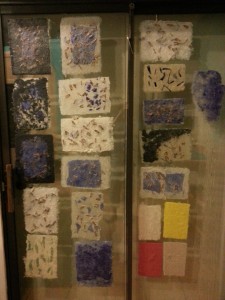
Woke up to find that the papers made with thicker abaca fibers had molded. Horrors! The uncooked seeds had some residual spores on them which ‘bloomed’ overnight (duh!). Arrrrgh. Treated them with hydrogen peroxide, which helped to bleach the mold. They look okay now, but I can’t put moldy papers (or seeds, for that matter) in this piece.
The kozo (translucent papers) embedded with the seeds look great…can’t use ’em, but they look great nonetheless.
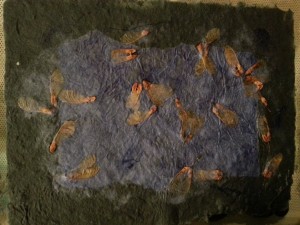
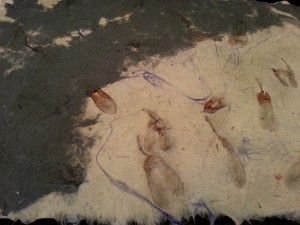
The papers I made without the seeds are archival. They don’t have anything to do with samaras or samarium, but they sure look purty.
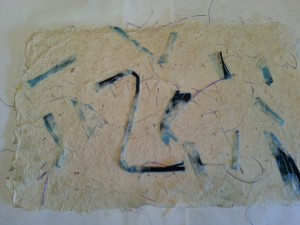
Now to explore silk ‘paper’-making. Thanks to my friend Mary Lee Erdman, I have just the reference book I need. I will leave the maple seeds out of it….
I have thought quite a bit about my options for the Radical Elements piece since I posted ‘The List’ of possible materials. My research has taken some interesting turns, including making some aerodynamic origami (check out the video here–the cats love it, but I don’t think it is going to make the final cut.). Two or three options are ‘percolating’ in my brain about how to go with this project. They are not necessarily mutually exclusive, but I am thinking of them as distinct at this point.
One way is go is with a play on the word Samarium. I choose this element because of my samaras series and my use of maple seed (maple seed = winged tree fruit = samara) imagery in my work. With this option, I could, for instance, make handmade papers from maple seeds, and use techniques borrowed from my textile work (screen printing, foil, etc.) to make a paper samaras quilt. I like this option, though I know nothing about papermaking. A paper piece like this that ‘references’ a quilt could be really beautiful. It also seems a bit simplistic–if not boring–to just use papers instead of fabric, layer them and stitch with raffia or something similar, and call it done. Issues I must consider are the archival properties of handmade paper, durability, and hanging issues.
Another way to go is to borrow materials from the ways samarium is useful (with none of the maple seed imagery). That would be in nuclear fuel rods (they have a gorgeous blue glow), audio equipment (headphones and Fender guitars), cancer treatment (both curative and palliative), the motion picture industry, and magnets. This option has all kinds of possibilities. Backlighting with blue LED lights…stitching with guitar strings, film strips, and IV lines….Cds layered on steel with magnet ‘stitches’…to name just a few. With this option, I have to think about power, archival issues, and test magnet strengths, etc. Also, I would like the final work to be beautiful, on some level, and avoid a messy, disjointed conglomeration.
Another option that is ‘percolating’ would involve an interactive component.
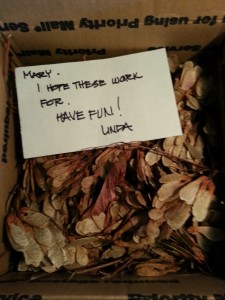
I reconnected with a high school friend who studied paper engineering. Several online connections will send me springtime samaras, and another harvested a fall crop for me in Washington state. There is more research to be done. In the meantime, I am enrolled in a one-day papermaking class with Catherine Nash. Should be fun…
I will keep you posted. What do you think?
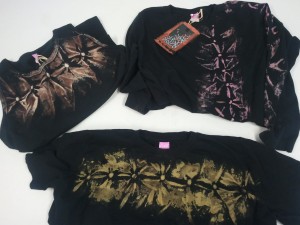
Catch me at the Quilt Fiesta this weekend. I will have lots of ‘little gems’ (small art quilts) matted and/or framed for sale, along with my Shibori Chic clothing….I am sharing a booth with Trish Hastings-Sargent, who does wonderful landscape quilts. Be there or be square…
See you at the show!
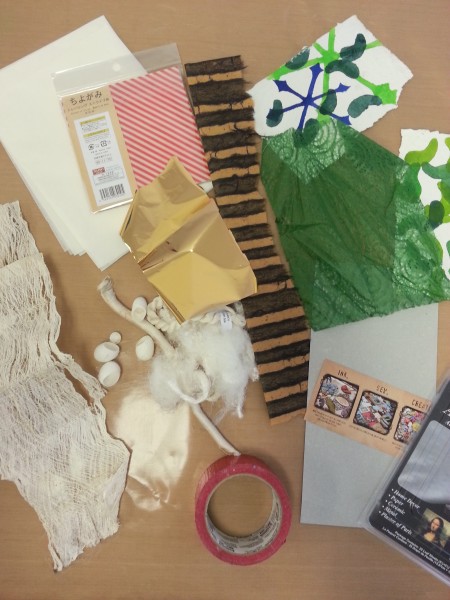
Okay. So I have been compiling ever-growing lists of both materials and imagery that may make it into the final piece for the Studio Art Quilt Associates’ Radical Elements exhibition. Jill Rumoshosky Werner, ‘Curator to the Stars,’ as she calls herself, has encouraged us to go far and wide in pursuit of our radical elements to replace the fabric and thread in our ‘art quilts.’
Remember, my element, samarium, is used in nuclear reactor rods, cancer treatments (both curative and palliative), and is magnetic. I have also found that it is used in the music industry–in guitars, headphones, etc. (Go figure.) I chose it as a play on words with ‘samaras’ or maple seeds, the imagery I use in one of my series. Here is the list of possible materials and/or imagery to date, in no particular order:
My next step will be to start experiment with painting and printing on, and assembling some of the materials. The final work will ‘reference the layering and stitching’ of a quilt. So, what have I missed???? Leave your suggestions here…nothing is too outrageous.

As many of you know, I recently applied to be a part of the Studio Art Quilt Associates‘ Radical Elements exhibition. The exhibition will be seen only in galleries and museums (not quilt shows) and is designed to highlight SAQA’s new definition of a quilt: The art quilt is a creative visual work that is layered and stitched or that references this form of stitched layered structure.
It was an honor to be accepted with such prestigious company as Wen Redmond, Pam RuBert, Elin Noble, and 36 other artists (see full list of participating artists here). I had researched the Periodic Table and found out there was an element called Samarium. I thought I would submit the next planned work from my Samaras series and leave it at that. My application was accepted.
Then I read the fine print.
It turns out I have to incorporate materials OTHER THAN fabric and thread. Hence the RADICAL ELEMENTS theme. Is that curator Jill Rumoshosky Werner clever or what????
First, some background information for those of us who are are not chemical engineers. Samarium is a white, shiny rare earth metal. It is used in nuclear reactor rods to absorb radiation, cancer treatments, and is magnetic. It is not particularly toxic, nor is it required to support life. Our bodies contain small amounts of Samarium.
I am in the process of collecting all suggestions for the requisite alternate materials. This is the brainstorming phase, so nothing is too crazy. Please leave your comments/suggestions below. My next post will include the full list of suggestions and future posts will show my experiments as I develop the work for this exhibition. The final work is due in September, and you will have to see it in person. The curator has asked that no pictures of finished work appear online.